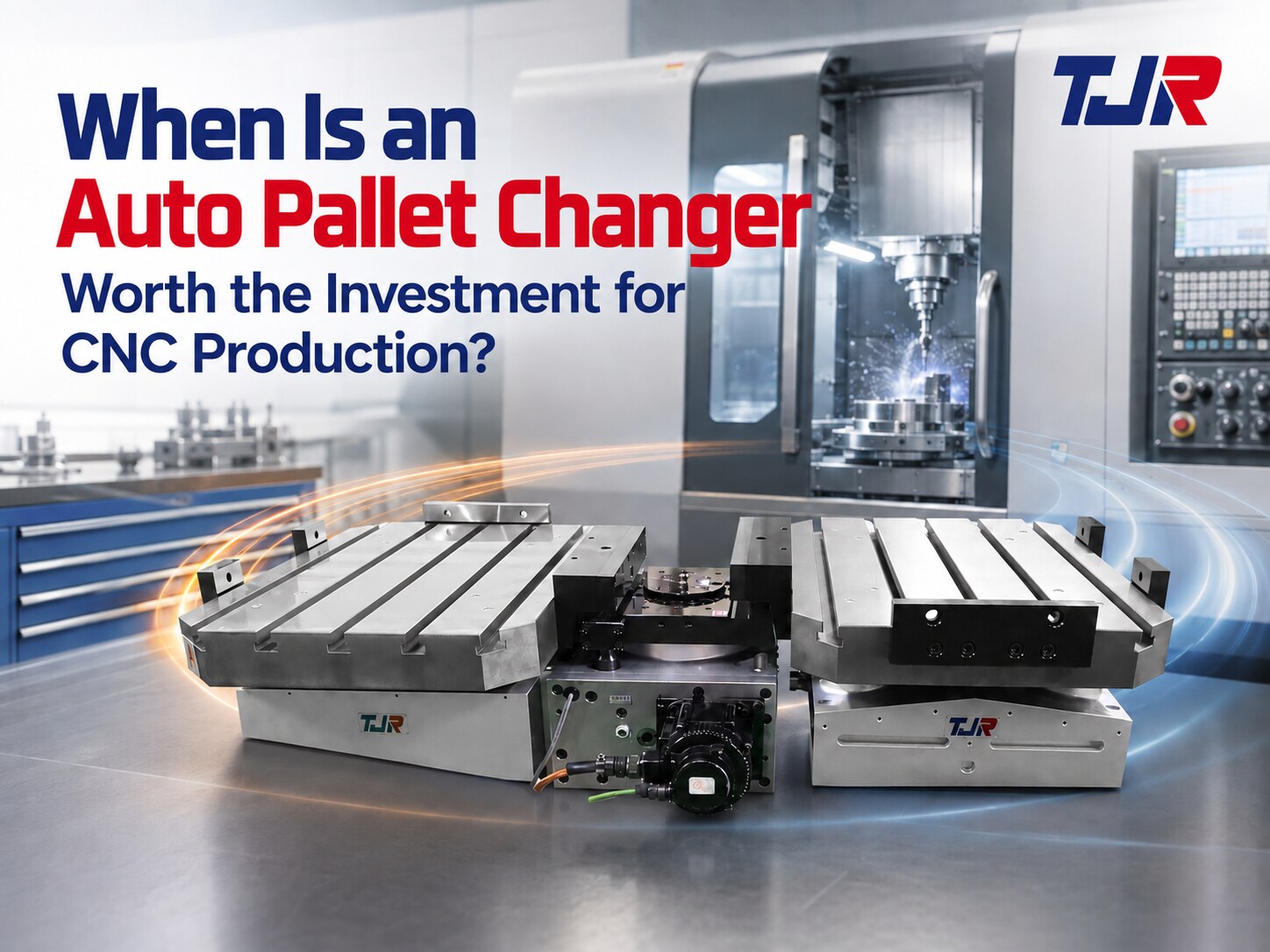
An auto pallet changer can reduce the time a CNC machine waits for workpiece unloading, loading, inspection, cleaning, and fixture preparation. However, the value of this investment depends on production conditions—not simply on whether pallet automation is available.
For manufacturers evaluating CNC productivity, the more useful question is whether enough machine waiting time can be converted into productive machining time. Production volume, changeover frequency, cycle time, workpiece weight, fixture repeatability, staffing, machine layout, and process stability should all be reviewed before selecting a pallet-changing solution.
TJR Precision Technology Co., LTD. provides automatic pallet changer configurations for vertical and horizontal machining applications. This guide explains how manufacturers can determine whether an APC fits their production requirements and what information should be prepared before discussing a suitable configuration.
1. What an Auto Pallet Changer Actually Improves
An auto pallet changer does not eliminate workpiece preparation. Its main purpose is to move a significant portion of that preparation away from the machine’s cutting area. While one pallet is inside the machine, an operator or automated process can prepare another pallet outside the enclosure.
When the current machining cycle finishes, the prepared pallet can be exchanged with the completed pallet. This overlap can reduce the period during which the spindle is stopped solely because the next workpiece is not ready.
Typical activities that may be moved offline
- Removing a finished workpiece from the fixture
- Cleaning the pallet and locating surfaces
- Loading and locating the next workpiece
- Applying the required clamping procedure
- Performing selected in-process checks
- Preparing fixtures for the next scheduled part
The improvement therefore comes from overlapping preparation with machining. It should not be presented as the removal of setup work or as a guarantee that every setup-related delay will disappear.
- An APC primarily reduces machine waiting caused by pallet and workpiece handling.
- The largest benefit comes when offline preparation can occur during a sufficiently long machining cycle.
- Fixture cleaning, inspection, loading, and clamping still require proper procedures.
2. The Production Conditions That Make an APC Valuable
An APC tends to provide stronger value when machine waiting time occurs repeatedly and can realistically be replaced by productive cutting time. The decision should begin with actual production records rather than a general assumption that automation always increases output.
Frequent pallet or workpiece changes
If operators stop the machine many times per shift to unload, clean, load, locate, and clamp parts, even a modest delay per change can accumulate into a substantial amount of non-cutting time.
Machining cycles long enough for offline preparation
The next pallet should ideally be ready before the active machining cycle is complete. If preparation consistently takes longer than machining, an APC may still reduce part of the waiting time, but it will not remove the entire delay.
Stable and repeatable production
Repeat jobs, part families, fixture-based production, and scheduled batch manufacturing usually make it easier to standardize pallet preparation. Highly variable work with constant engineering changes may require a more detailed evaluation.
Existing demand for additional machine capacity
Recovering machine time has commercial value when the shop can use that capacity. This may include reducing a backlog, supporting growth, improving delivery performance, extending unattended operation, or avoiding premature investment in another machine.
Operator responsibilities across multiple machines
Offline pallet preparation can give operators greater flexibility in organizing work. However, labor savings should not be assumed automatically. Actual staffing benefits depend on cycle time, travel distance, inspection duties, material handling, and the number of machines assigned to each operator.
- High production volume alone does not prove that an APC is necessary.
- Change frequency and recoverable waiting time are more useful decision indicators.
- The recovered capacity must support real production demand to create financial value.
3. How to Estimate Recoverable Machine Time
Before requesting a quotation, manufacturers should measure the machine’s current waiting time over several representative shifts. Separate pallet-related delays from other losses such as tool changes, alarms, programming issues, inspection holds, material shortages, and maintenance downtime.
A practical first estimate is:
For example, if the machine currently waits eight minutes during each pallet-related change and the expected remaining delay after integration is two minutes, the recoverable time is approximately six minutes per change. At eight changes per shift, this represents about 48 minutes of potential machine availability.
This is an operating estimate rather than a guaranteed result. The remaining waiting time may be affected by pallet exchange speed, door operation, program confirmation, probing, cleaning, workpiece verification, safety procedures, and the operator’s ability to prepare the next pallet on time.
Information worth recording
| Production Data | Why It Matters |
|---|---|
| Average machining cycle time | Shows how much time is available for offline pallet preparation. |
| Current loading and unloading time | Identifies the delay most directly affected by pallet changing. |
| Changes per shift | Determines how often the potential saving can be repeated. |
| Remaining confirmation time | Prevents the estimate from assuming that all waiting will disappear. |
| Available production demand | Shows whether recovered time can become useful output. |
| Labor and overtime conditions | Supports a more complete operating-cost comparison. |
Manufacturers can then compare the estimated annual benefit with the APC investment, integration work, fixture requirements, training, maintenance, and any necessary machine or layout modifications.
- Measure current waiting time instead of relying on a general production estimate.
- Subtract the delays that will remain after pallet automation.
- Evaluate annual usable capacity, not only minutes saved per exchange.
4. When an APC May Not Deliver the Expected Return
An auto pallet changer is not automatically the best investment for every CNC operation. The following conditions may weaken the business case or require additional process improvements first.
Very low pallet-change frequency
If one workpiece remains in the machine for most of a shift, the number of pallet exchanges may be too low to recover meaningful time.
Preparation takes longer than the machining cycle
Short cutting cycles combined with lengthy loading, fixturing, cleaning, or inspection can leave the machine waiting even when two pallets are available.
Unstable fixtures or inconsistent workpiece location
An APC repeats pallet movement, but it does not correct poor fixture design, contamination on locating surfaces, inconsistent clamping, or unstable workpiece references. These problems should be controlled before increasing automation.
Insufficient production demand
If the machine already has unused capacity, increasing available cutting time may not produce a measurable financial return. Other benefits may still matter, but they should be identified clearly.
Machine and layout incompatibility
The available floor space, machine structure, table interface, guarding, access, control signals, utilities, and safety requirements must support the intended installation. An APC should not be treated as a universal accessory that can be added to every machine without engineering review.
- An APC cannot compensate for unstable fixturing or poor process control.
- Low exchange frequency can significantly extend the payback period.
- Compatibility and integration must be confirmed before purchase.
5. VMC and HMC Pallet-Changing Requirements
The required pallet-changing arrangement depends partly on the machine configuration. A vertical machining center and a horizontal machining center do not necessarily use the same pallet orientation, transfer arrangement, loading method, or supporting rotary-table configuration.
| Evaluation Area | VMC Considerations | HMC Considerations |
|---|---|---|
| Workpiece access | Top access and operator loading height should be reviewed. | Side access, pallet orientation, and station clearance are important. |
| Pallet arrangement | Exchange layout must match the machine table and available space. | Pallet handling may be combined with a rotary-table configuration. |
| Workpiece load | Total pallet, fixture, and workpiece mass must remain within the applicable capacity. | Load, moment, center of gravity, and rotary requirements should be evaluated together. |
| Integration | Machine enclosure, control sequence, guarding, and table interface require confirmation. | Rotary-axis operation, pallet exchange, orientation, and machine control require coordinated integration. |
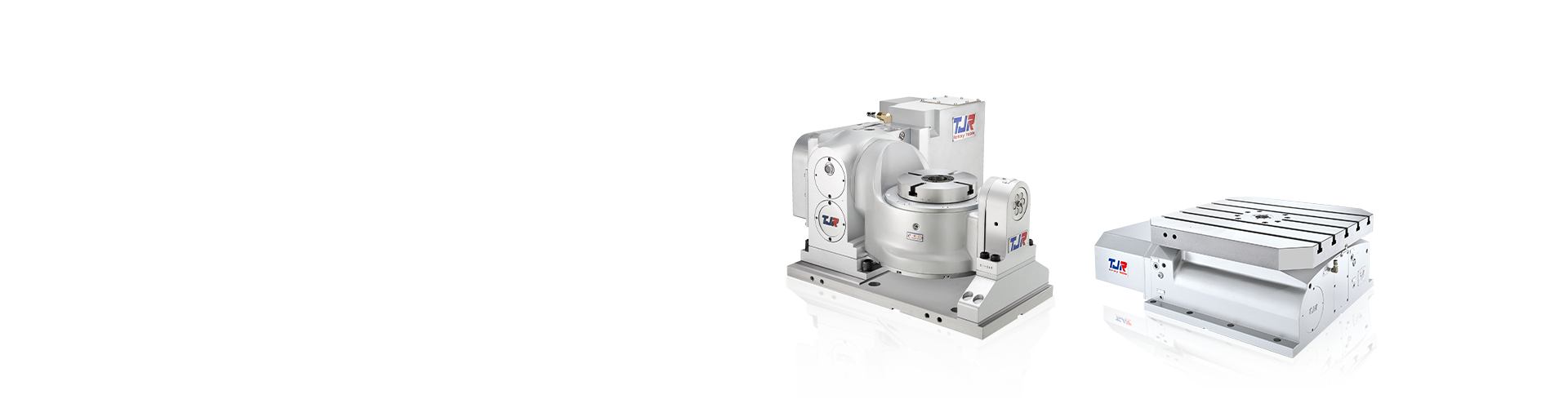
TJR’s VMC pallet-changer range includes the CTU Series and CURC Series. For HMC applications, TJR provides CTH pallet changer configurations combined with CHI or CHR dual-pallet rotary tables. The appropriate solution should be determined according to machine layout, pallet size, load, positioning requirements, and control integration.
- VMC and HMC applications require different mechanical and integration evaluations.
- Pallet size alone is not sufficient for selecting a system.
- Fixture mass, workpiece mass, center of gravity, and machining forces must be considered.
6. What to Check Before Selecting a System
A suitable APC must match more than the nominal machine table size. Preparing complete application information allows the manufacturer and system supplier to evaluate feasibility more accurately.
Machine information
- Machine brand, model, and table dimensions
- Machine layout and enclosure configuration
- Available control signals and interface requirements
- Current table, rotary table, or pallet arrangement
- Required machining orientation and axis movement
Load information
- Workpiece dimensions and weight
- Fixture dimensions and weight
- Total load on each pallet
- Load distribution and center of gravity
- Expected cutting conditions and machining forces
Production information
- Average cycle time
- Required changes per shift
- Part mix and batch size
- Loading, unloading, cleaning, and inspection procedures
- Current machine waiting time
Installation and safety information
- Available floor space and access routes
- Operator loading position and ergonomic requirements
- Guarding, doors, interlocks, and safe operating zones
- Utility, maintenance, and service access
- Responsibility for machine integration and commissioning
Machine guarding and safe integration should follow applicable regulations and the risk assessment for the complete machine system. Requirements can vary by market and application.
- Provide the machine model, pallet requirements, load data, layout, and production cycle.
- Include fixture weight and workpiece center of gravity—not only workpiece weight.
- Confirm control, guarding, installation, and commissioning responsibilities early.
7. How TJR APC Configurations Support CNC Production
TJR Precision Technology Co., LTD. develops rotary tables and pallet-changing solutions for machine-tool applications. Its APC product range covers configurations intended for vertical and horizontal machining environments.
For vertical machining centers, the CTU Series and CURC Series provide integrated automatic pallet-changing configurations. For horizontal machining applications, the CTH pallet changer can be combined with CHI or CHR dual-pallet rotary tables.
Because machine construction, control systems, available space, pallet dimensions, and machining requirements differ, product selection should be based on application data. TJR’s published product information can be used as an initial reference, followed by technical confirmation for the intended machine and production process.
- TJR offers APC configurations for both VMC and HMC applications.
- HMC solutions can combine a CTH pallet changer with CHI or CHR dual-pallet rotary tables.
- Final selection requires machine and application confirmation.
8. Final Investment Checklist
An auto pallet changer is most likely to create value when the production process has measurable pallet-related waiting time, the next pallet can be prepared during machining, and the recovered machine time can be used productively.
Before requesting a quotation, confirm:
- How many minutes does the machine currently wait during each pallet-related change?
- How many changes occur during each shift?
- Can the next pallet be completely prepared before machining finishes?
- Is the production process stable enough for repeatable pallet handling?
- Is there enough demand to use the recovered machine capacity?
- Are the machine interface, layout, control, and guarding compatible with the proposed system?
- Have the pallet, fixture, workpiece, load distribution, and center of gravity been confirmed?
- Have installation, training, maintenance, and integration costs been included?
If several of these questions cannot yet be answered, the next step should be production measurement and technical evaluation rather than selecting a system by pallet dimensions alone.
- Base the investment decision on recoverable waiting time and usable capacity.
- Evaluate technical feasibility and financial value together.
- Prepare complete machine and production data before discussing configuration.
Frequently Asked Questions
What does an auto pallet changer do?
An auto pallet changer exchanges a pallet inside the machining area with another pallet at a loading or preparation station. This allows the next workpiece and fixture to be prepared while the machine is processing the current pallet.
Does an APC eliminate CNC setup time?
No. Loading, unloading, cleaning, inspection, locating, and clamping still require time. An APC can move some of these activities offline so that they overlap with machining, reducing machine waiting rather than eliminating setup work.
Is an auto pallet changer suitable only for mass production?
No. It can also support repeat batches, part-family production, mixed manufacturing, or operations with frequent pallet changes. The key factor is whether enough waiting time can be recovered and used productively.
Can an APC be added to any existing CNC machine?
Not automatically. The machine structure, table interface, control system, enclosure, layout, load, access, guarding, and installation requirements must be evaluated before compatibility can be confirmed.
What information should be provided when requesting an APC quotation?
Provide the CNC machine brand and model, table dimensions, pallet size, fixture and workpiece weights, center of gravity, cycle time, required exchange frequency, machine layout, control information, and available installation space.
Evaluate the Right APC Configuration for Your CNC Application
Share your machine model, pallet dimensions, fixture and workpiece load, cycle time, production requirements, and layout information with TJR. Our team can use this information to discuss an appropriate automatic pallet changer configuration for your application.
Contact TJRMore Articles
Review the main technical considerations when expanding CNC machining capability.
Understand how dual-axis rotary tables support multi-sided machining.
Explore selection considerations for demanding precision-machining applications.