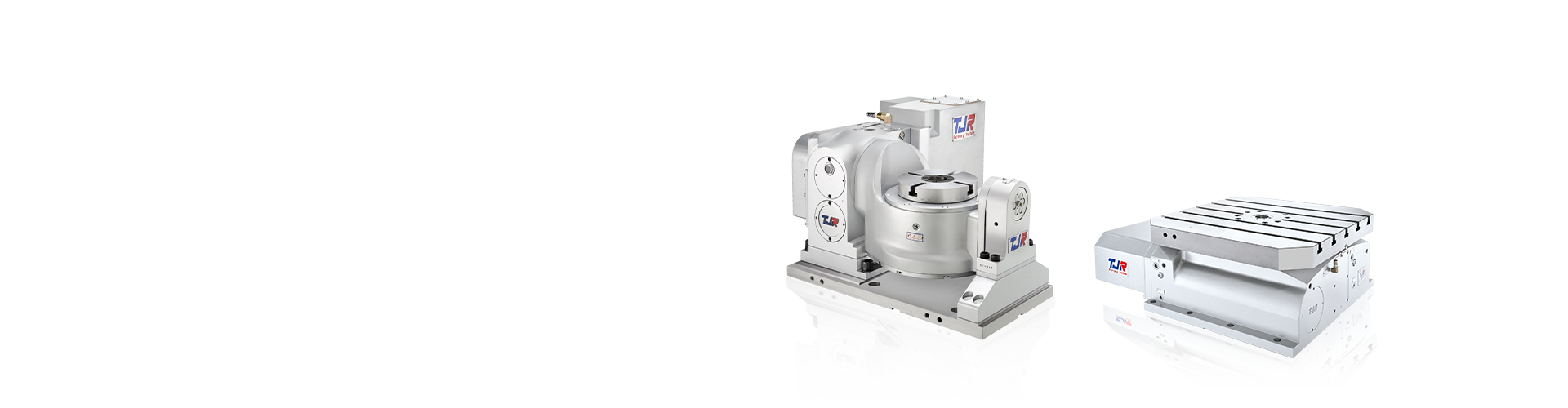
In modern CNC machining, manufacturers are constantly looking for ways to improve efficiency, precision, and flexibility. One of the most important technologies enabling this transformation is the dual axis rotary table.
A dual axis rotary table, also known as a 5-axis rotary table, is a key component that allows workpieces to be machined from multiple angles in a single setup. By integrating this system into a machining center, manufacturers can unlock true multi-axis machining capability and significantly enhance production performance.
A dual axis rotary table is a machining device equipped with two rotational axes, typically combining a tilting axis and a rotary axis. This configuration allows the workpiece to both rotate and tilt, enabling access to multiple surfaces without manual repositioning.
In CNC terminology, this type of system is widely used to achieve 5-axis machining. For this reason, dual axis rotary tables are commonly categorized as 5-axis rotary table solutions in industrial applications.
A dual axis rotary table operates through synchronized motion control between its rotational axes and the CNC machine. The workpiece is mounted securely on the table, and the CNC system controls both axes simultaneously to adjust its position dynamically during machining.
This coordinated movement allows cutting tools to access complex geometries and multiple angles continuously, making it possible to complete intricate machining processes in a single setup.
One of the most significant advantages of a dual axis rotary table is the ability to perform one-time clamping. Instead of repeatedly removing and repositioning the workpiece, the entire machining process can be completed in a single setup, reducing alignment errors and improving dimensional consistency.
By eliminating multiple setups, manufacturers can reduce downtime and increase throughput. This leads to shorter cycle times and improved production efficiency.
Dual axis rotary tables make it possible to machine complex shapes such as curved surfaces, angled features, and 3D contours, which are commonly found in advanced industrial applications.
Continuous multi-axis movement enables smoother tool paths, resulting in improved surface quality and reduced machining marks.
Compared to a traditional single-axis rotary table, a dual axis system offers significantly greater flexibility. A single-axis table allows only rotational movement, while a dual axis rotary table enables both rotation and tilting, making it ideal for multi-angle machining.
This is why many manufacturers upgrade from 4th axis systems to 5-axis rotary table solutions when handling complex parts.
Dual axis rotary tables can be categorized based on their transmission mechanisms:
Each type is designed to meet different machining requirements, allowing manufacturers to select the most suitable solution based on their production needs.
Dual axis rotary tables are widely used in industries that require high precision and complex machining:
In many CNC applications, a dual axis rotary table is used as a practical solution to upgrade a standard 3-axis machining center into a 5-axis system. By enabling rotation and tilting simultaneously, it provides the flexibility required for modern multi-axis machining.
This is why dual axis rotary tables are considered a fundamental part of 5-axis rotary table solutions in today’s manufacturing environment.
A dual axis rotary table is more than just an accessory—it is a key technology that enables efficient, precise, and flexible machining. By combining two rotational axes, it allows manufacturers to complete complex parts in a single setup, improving productivity and reducing errors.
As manufacturing continues to evolve toward higher precision and efficiency, integrating a dual axis rotary table into your machining process is a strategic step toward achieving true 5-axis capability.
With years of expertise in rotary table engineering, TJR Precision Technology is a trusted manufacturer of high-performance 5-axis rotary table solutions. Our products are designed to meet the demanding requirements of aerospace, automotive, and high-tech industries, delivering exceptional rigidity, precision, and long-term reliability.
Whether you are upgrading an existing machining center or building a new production line, TJR provides flexible dual axis rotary table configurations tailored to your application needs.
Contact TJR today to explore the right solution for your machining requirements and take your production efficiency to the next level.